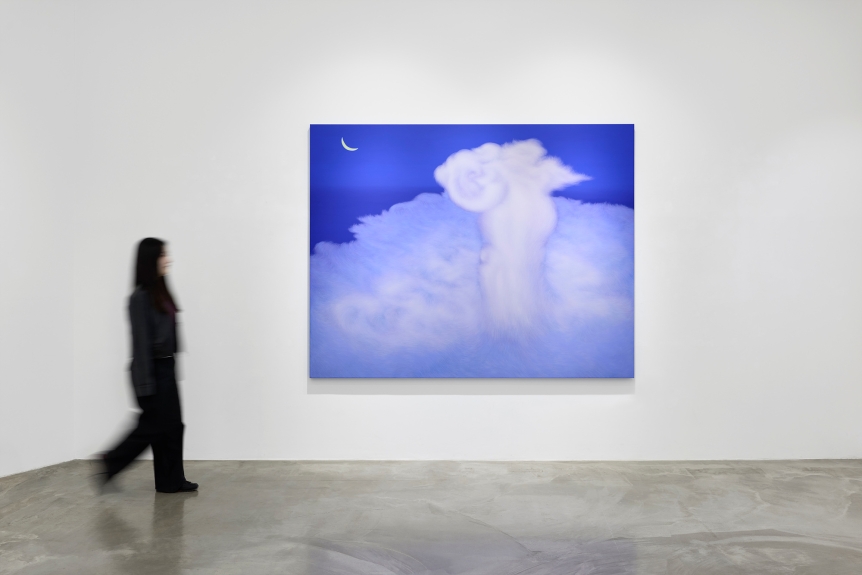


정유미 개인전 유수음(流水音) Flowing Volume | 2026.5.1-6.20 | 아뜰리에 아키
수평선상의 선율: 《유수음(流水音) Flowing Volume》에 부쳐
콘노 유키 (미술비평가)
산을 오르다가 소리를 듣는다. 위에서 아래로 내리치는 폭포를 소리로 듣는다. 어느 날은 강가에서 앉아 있다가 물 흐르는 소리에 귀를 기울인다. 내가 있는 곳을 향해 소리가 들려온다. 숲에 가려져 있거나, 일면의 파란색으로만 보였다가, 거기에 미세한 움직임이 주어지자 우리는 주변을 공간적으로, 입체적으로 인지하게 된다. 그 너머에 무언가 있다는 것, 그 이면에 요동치는 힘이 있다는 것을 깨닫는다. 우리를 압도하고 때때로 넋을 놓게 하는 자연은 사실 미세한 움직임의 집합체가 아닐까. 고대 산수화에도 자연을 가까이 즐기는 인간의 시선이 반영되어 있다. 예로부터 ‘기운생동(氣韻生動)’이라는 말을 쓰지만, 이는 단순히 관조적 시선으로 본 경험이 아니다. 인간은 자연이 생동하는 것을 느끼며, 자신도 자연 앞에서 생동한다. 기운생동이란 자연과 인간이 함께 호흡하는, 공간화된 경험에 의한 것이다.
‘유수음’이라는 개인전 제목은 정유미가 ‘흐르는 물소리(流水音)’라는 한자에서 가지고 온 것이다. 흐르는 물소리처럼, 우리는 유수음을 소리 내어 말해 본다. 거친 마찰음보다 여린 숨결에 가까운 이 표현과 정유미의 회화는 어떻게 연결될까. 혹자는 그의 회화가 상공에서 바라본 구름이나 기류와 같다고 할 수도 있다. 그렇게 생각해 볼 때, 미세한 유수음과 거대한 자연물은 서로 대조된다. 하지만 앞서 말했듯이, 자연의 숨결은 오히려 커다란 전체와 세부의 호응에 의한 움직임이라 할 수 있다. 정유미는 ‘상상풍경(想像風景 Imaginary Landscape)’이라는 말을 통해서 그간 작업해 왔다. 회화로써 그려지는, 그러니까 머릿속에 그려지는 풍경은 물 흐르는 듯한 상상을 통해 출현한다. 뭉게뭉게 피어오르는 형태는 구름이나 물결을 모사한 재현이 아니라, 이들의 성질을 바탕으로 회화와 보는 사람의 호흡 안에 또 다른 이미지를 탄생케 한다.
개인전 《유수음(流水音) Flowing Volume》에서 소개하는 작업도 ‘상상풍경’의 연장선에 있다. 이번 전시에서 강조된 부분은 소리를 관념적으로 형상화한 지점이다. 청각적인 요소는 회화에/회화로써 어떻게 그려질 수 있을까? 회화에 눈으로 귀 기울이는 방식—멀리서 전체를 바라보고, 가까이서 획의 방향과 색의 중첩을 본다. 그러면서 마음속에 형상을 찾고 머릿속에 형태를 떠올려보기. 자연에 몸담던 시간 못지않게, 보는 사람은 회화 안에 몸담을 자리를 찾게 된다. ‘Volume’은 소리이며, 부피와 ‘덩어리감’이 된다. 물이 결을 갖듯이, 회화 또한 색의 조합이나 특정 대상의 재현에 귀결되지 않는다. 소리가 저 멀리서 들려오듯이, 우리는 공간화된 자연을 보기만 하는 대신 심상을 통해 풍경을 공간화하여 소유한다. 획의 미세한 떨림은 소리가 되어, 우리가 보는 풍경 안에 결을 만들어 시각적인 부피를, 상상을 키운다. 궁극적으로 유수음은 숨결이 되어 보는 이와 회화 사이에 진동을, 마음을 살아 있게 하는 흐름을 만든다.
정유미의 회화를 보면서 우리는 풍경을 조율한다(tuning). 여기서 조율이란 공통의 기준음에 맞추는 대신, 시선을 회화와 나를 향해 보내며, 그 결을 따라 이미지를 떠올리며 그려나가는 과정이다. 소리 없는 곳은 소리가 처음부터 없었던 것은 아니다. 정유미의 회화 또한 침묵이 아니다. 유수음은 회화와 감상자 사이의 침묵을 깨러 우리에게 찾아온다. 폭포, 바다나 강가에서 우리는 가만히 바라보기만 하지 않는다. 정적이지만, 자연에 몸담는 경험은 인간에게 심상을 그리도록 한다. 눈앞에 내리치는 폭포의 에너지는 망망대해를 하염없이 보는 것과 동질적이다. 말하자면, 에너지가 보는 사람에게 흘러 들어온다는 의미에서, 폭포 앞에서 느껴지는 에너지는 해안가에서 바라보는 것과 강약의 차이만 날 뿐이다. 순간적이거나 잔잔하거나, 우리는 정유미의 회화와 조율하면서, 마음을 사로잡는 주파수에 반응하여 시각적으로 찾아 나선다.
구름의 성질은 수증기의 일시적 응결체이다. 하늘로 올라가기도, 지상으로 내려오기도 하는 것. 펼쳐진 바다가 미세한 물결에 하늘을 품어 안는다. 결은 우리가 보고 떠올리는 것에 부피감을 더한다. 정유미의 회화는 저 수평선 너머에서 나를 찾아오며, 심상을 입체적으로 그려나가도록 한다. 구름과 물결이 바람의 방향이나 기상 조건에 따라 형태가 달라지듯이, 회화와 우리 또한 동력을 받아 조율하면서 같이 움직인다. 상상은 늘 결을 가진다. 순간 떠오른 이미지는 현 위치에서 잠시 이탈시켜, 우리를 부유하게 한다. 부유(富裕)함은 또 다른 부유(浮遊)함, 그러니까 풍성한 상상과 형태를 탄생케 한다. 그런 의미에서, 정유미의 회화는 가스통 바슐라르(Gaston Bachelard)가 물을 둘러싼 이야기를 연구하여 말한 바와 같다—풍성한 것은 무거워진다. 이토록 많은 반영과 그림자로 충만한 물은, 무거운 물이다.1 유수음의 결은 미세할지 몰라도, 우리를 사로잡는 질감을 갖는다.
1. ガストン・バシュラール, 及川 馥(訳), 『水と夢 〈新装版〉: 物質的想像力試論』, 法政大学出版局, 2016, p.91(가스통 바슐라르, 『물과 꿈 : 질료에 관한 상상력 시론』, 일역본)
A Melody on the Horizon: 《유수음(流水音) Flowing Volume》
Yuki Konno (Art Critic)
When climbing a mountain, we encounter sound. The waterfall, striking downward from above, is first encountered as sound rather than image. At other times, sitting by the river, we listen closely to the flow of water. The sound moves toward us. At times it is hidden by the forest, or appears only as a flat field of blue; yet with even the slightest movement, the surroundings begin to register as spatial and three-dimensional. We come to sense that something lies beyond it, that a force is stirring beneath the surface. Nature, which overwhelms us and at times leaves us momentarily absorbed, may in fact be an accumulation of minute movements. In ancient landscape painting, the human gaze is already positioned in close relation to nature. The term giun saengdong (氣韻生動) has long been used, yet it is not simply the result of detached contemplation. One feels the vitality of nature, and in doing so becomes vital in its presence. Giun saengdong can thus be understood as a spatial experience, one in which nature and humans breathe together.
The title of the exhibition, Flowing Volume, is drawn from the Chinese characters meaning “the sound of flowing water” (Yusu-eum, 流水音). Like the sound itself, the word feels soft when spoken; closer to a quiet breath than a sharp, frictional sound. How does this quality connect to Yumi Chung’s paintings? Some may see her work as resembling clouds or air currents viewed from above. In that sense, the subtle sound of yusu-eum might seem at odds with the scale of nature. Yet, as suggested earlier, the breath of nature is not separate from its vastness: it emerges from the interaction between the whole and its smallest details. Chung has long explored Imaginary Landscape (想像風景), in which the landscapes in her paintings are not directly observed but emerge through imagination, unfolding with a fluid, water-like movement. The softly billowing forms do not replicate clouds or waves; rather, drawing on their inherent qualities, they give rise to new images within the shared breath of the painting and the viewer.
The works presented in Flowing Volume (Yusu-eum, 流水音) continue Chung’s Imaginary Landscape series, with a particular focus on the conceptual visualization of sound. How can sound be painted? The works suggest a way of looking that is also a kind of listening, taking in the whole from a distance, then moving closer to follow the direction of each stroke and the layering of color. In this process, the viewer begins to form images in the mind, allowing images to emerge internally and finding a place to inhabit within the painting. Here, “volume” refers both to sound and to physical mass, or a sense of density or presence. Just as water carries its own grain, the paintings do not resolve into fixed compositions or straightforward representations. Like sound heard from afar, the landscape is not simply seen, but experienced as something spatial. The subtle tremor of each brushstroke becomes sound, creating texture within the image that builds visual volume and expands the space of imagination. Ultimately, Yusu-eum becomes a kind of breath, generating a quiet vibration between the painting and the viewer, and setting into motion a living flow within the mind.
In encountering Yumi Chung’s paintings, we find ourselves “tuning” the landscape. Here, tuning does not mean matching a fixed frequency, but letting our gaze move between the painting and ourselves, following its textures as images begin to take shape in the mind. Silence does not mean that sound was never there. Chung’s paintings are not silent; Yusu-eum arrives as something that gently breaks the quiet between the work and the viewer. In the presence of a waterfall, the sea, or a river, we do not simply stand and look. Even in stillness, the experience of being immersed in nature prompts us to create images in the mind. The force of a waterfall striking before our eyes is, in essence, akin to gazing out over an open sea: both are experiences in which energy flows toward the viewer, differing only in intensity. Whether sudden or subtle, we attune ourselves to Chung’s paintings, responding to the frequencies that draw us in, and begin to search for images within the visual field.
Clouds are, by nature, temporary condensations of water vapor, rising into the sky or drifting back down toward the earth. The open sea, in its fine ripples, embraces the sky within itself. Texture gives volume to what we see and imagine. In Yumi Chung’s paintings, something seems to approach from beyond the horizon, inviting the viewer to form images with a sense of depth. Just as clouds and waves change with the direction of the wind and shifting weather, the painting and the viewer move together, responding to the forces that shape them. Imagination, too, has its own texture. A fleeting image can gently displace us from where we are, allowing us to drift. This sense of richness (buyu, 富裕) becomes another kind of floating (buyu, 浮遊), giving rise to abundant forms and images. In this way, Chung’s work recalls Gaston Bachelard’s reflections on water: what is full becomes heavy. Water, filled with reflections and shadows, carries its own weight.1 The texture of Yusu-eum may be subtle, but it holds a presence that captivates and draws us in.
1. ガストン・バシュラール, 及川 馥(訳), 『水と夢 〈新装版〉: 物質的想像力試論』, 法政大学出版局, 2016, p.91(Gaston Bachelard 『Water and Dreams: An Essay on the Imagination of Matter』 , Japanese edition)
(Translation: Jasmine Park)